
This guide explains what a basket-type strainer is, how it works, and how to choose the right one for your line.
A strainer basket type helps catch dirt, rust, scale, and other solids before they reach pumps, valves, or machines. This keeps the flow cleaner and helps reduce damage in busy pipe systems.
Lianke Valve makes industrial valves and strainers for chemical, mining, power, food, paper, and wastewater use. Its products support lines that need strong control against corrosion, abrasion, and flow problems.
A basket-type strainer is a pipe part that removes solid waste from liquid flow. It has a body, a cover, and a removable basket screen.
The basket catches debris while the liquid passes through. The clean liquid then moves forward to the next part of the system.
If you are asking what a basket-type strainer is, the simple answer is this: it is a guard for your pipe system. It helps protect pumps, valves, meters, and other costly parts.
The working process is simple.
This design works well for lines with more dirt or higher flow. The basket has more holding space than many small screens.
Different types of strainers solve different plant needs. The right choice depends on flow load, cleaning needs, space, and downtime risk.
A simplex basket strainer has one basket. It works well when the line can stop during cleaning.
This type fits water lines, small process lines, and low-risk systems. It costs less than a duplex unit, but cleaning may pause the flow.
A duplex basket strainer has two baskets. One side can work while the other side gets cleaned.
This type suits chemical plants, cooling water lines, power systems, and other lines that should not stop. It helps reduce downtime during service.
An automatic basket strainer removes debris with less worker handling. Some designs use backwash or scraping systems.
This type works best for heavy debris, long shifts, and large plants. It may cost more, but it can save time in dirty or continuous flow lines.
| Type | Best For | Main Benefit | Main Limit |
| Simplex | Small lines | Lower cost | Flow stops for cleaning |
| Duplex | Continuous lines | One side runs during cleaning | Higher cost |
| Automatic | Heavy debris lines | Less manual cleaning | More complex design |
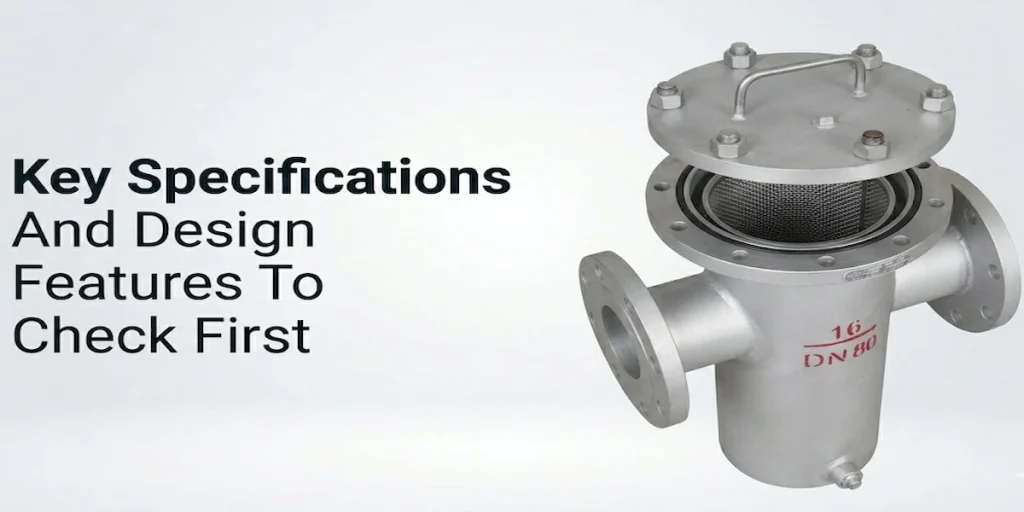
Check the key details before you choose an industrial strainer basket. The wrong size or material can cause low flow, leaks, or fast wear.
| Feature | What To Check | Why It Matters |
| Body material | Flanged, threaded, or welded | Matches fluid and corrosion risk |
| Basket mesh | Hole size or mesh grade | Controls what solids get caught |
| Pressure rating | System pressure and safety margin | Helps prevent body failure |
| Temperature range | Fluid heat level | Protects seals and metal parts |
| End connection | Flanged, threaded or welded | Fits the pipe system |
| Cover type | Bolted or quick-open | Affects cleaning speed |
For corrosive fluids, choose lined or stainless materials. For abrasive slurry, choose stronger baskets and wear-ready parts.
A basket-type strainer catalogue can help compare size, pressure class, connection type, and material. Use it with real system data, not just pipe size.
Basket Strainer vs Y Strainer is a common choice in plant design. Both remove solids from fluid, but they fit different needs.
A Y-type strainer has a compact body and a smaller screen area. It often works well in tight spaces, steam lines, and light debris service.
A basket strainer has a larger basket area. It suits high flow, more debris, and easier cleaning.
| Point | Basket Strainer | Y Strainer |
| Design & structure | Large body with removable basket | Y-shaped body with screen |
| Installation orientation | Mostly horizontal lines | Horizontal or vertical lines |
| Flow capacity | Better for high flow | Better for smaller lines |
| Pressure handling | Good for many liquid lines | Remove and clean the basket |
| Maintenance method | Remove the cap and clean screen | Remove the cap and clean the screen |
| Cost | Usually higher | Usually lower |
The difference between a y-type strainer and a basket-type strainer comes down to debris load, space, and cleaning needs.
Some buyers search for a 1/2 y strainer when they need a small pipe size. That may fit light-duty work, but larger dirty lines often need a basket design.
Choose a basket-type strainer if your line has high flow, heavy solids, or frequent cleaning needs.
Choose a Y strainer if space is tight, debris is light, or the pipe size is small.
Choose a duplex basket strainer if shutdowns cost too much. Choose an automatic unit if manual cleaning takes too much time.
Design starts with flow rate, pipe size, pressure, fluid type, and debris load. The basket, body material, and opening size must match the system.
A Y-type strainer suits compact systems and lower debris loads. A basket-type strainer handles higher flow, larger debris, and easier cleaning.
The best material depends on the fluid. Stainless steel suits clean or corrosive media, while lined materials help handle strong chemicals safely.
A strainer protects pumps, valves, meters, and pipelines by catching solid particles before they damage equipment or slow down the flow.

Valves are everywhere in industrial processes—controlling flow, isolating equipment, and protecting systems from overpressure. Yet for many engineers and technicians, the range of options can feel overwhelming. This guide covers the fundamentals of industrial valves, with a closer look at three widely used types: the lined valve, the pinch valve, and the stainless steel ball […]

Valve installation looks simple on paper—until you’re on-site, the flanges don’t line up, and the process fluid is waiting. In reality, poor installation is one of the leading causes of premature valve failure, leakage, and costly downtime. Whether you’re working with a lined valve, a strainer, or a pinch valve, the same fundamental rules apply. […]

Lianke Valve Co., Ltd. has just wrapped up a busy and rewarding season of site visits. Over the past two weeks, we have hosted several groups of clients from home and abroad. They came with different goals, yet all turned their attention to Lianke’s manufacturing strength and technical expertise. Juhua Group, Quzhou In early March, […]

Recently, the production workshop at Lianke Valve has been bustling with activity, where production, inspection, packaging and other processes operate in efficient coordination. After rigorous multi-stage quality checks, a batch of high-quality pinch valve products has been packed and shipped, setting off for Russia. Export Product Case The pinch valves in this bulk shipment are […]


