
This guide explains what a basket-type strainer is, how it works, and how to choose the right one for your line.
A strainer basket type helps catch dirt, rust, scale, and other solids before they reach pumps, valves, or machines. This keeps the flow cleaner and helps reduce damage in busy pipe systems.
Lianke Valve makes industrial valves and strainers for chemical, mining, power, food, paper, and wastewater use. Its products support lines that need strong control against corrosion, abrasion, and flow problems.
A basket-type strainer is a pipe part that removes solid waste from liquid flow. It has a body, a cover, and a removable basket screen.
The basket catches debris while the liquid passes through. The clean liquid then moves forward to the next part of the system.
If you are asking what a basket-type strainer is, the simple answer is this: it is a guard for your pipe system. It helps protect pumps, valves, meters, and other costly parts.
The working process is simple.
This design works well for lines with more dirt or higher flow. The basket has more holding space than many small screens.
Different types of strainers solve different plant needs. The right choice depends on flow load, cleaning needs, space, and downtime risk.
A simplex basket strainer has one basket. It works well when the line can stop during cleaning.
This type fits water lines, small process lines, and low-risk systems. It costs less than a duplex unit, but cleaning may pause the flow.
A duplex basket strainer has two baskets. One side can work while the other side gets cleaned.
This type suits chemical plants, cooling water lines, power systems, and other lines that should not stop. It helps reduce downtime during service.
An automatic basket strainer removes debris with less worker handling. Some designs use backwash or scraping systems.
This type works best for heavy debris, long shifts, and large plants. It may cost more, but it can save time in dirty or continuous flow lines.
| Type | Best For | Main Benefit | Main Limit |
| Simplex | Small lines | Lower cost | Flow stops for cleaning |
| Duplex | Continuous lines | One side runs during cleaning | Higher cost |
| Automatic | Heavy debris lines | Less manual cleaning | More complex design |
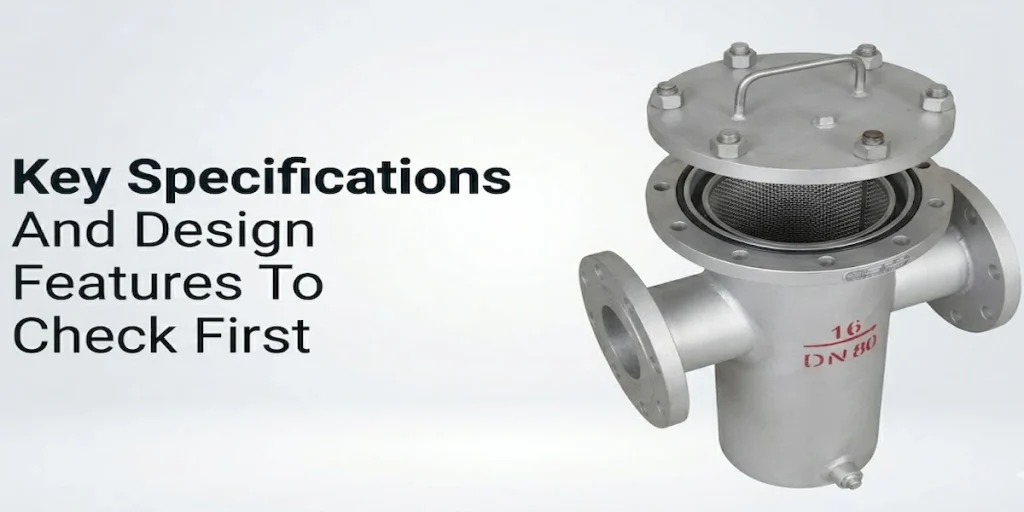
Check the key details before you choose an industrial strainer basket. The wrong size or material can cause low flow, leaks, or fast wear.
| Feature | What To Check | Why It Matters |
| Body material | Flanged, threaded, or welded | Matches fluid and corrosion risk |
| Basket mesh | Hole size or mesh grade | Controls what solids get caught |
| Pressure rating | System pressure and safety margin | Helps prevent body failure |
| Temperature range | Fluid heat level | Protects seals and metal parts |
| End connection | Flanged, threaded or welded | Fits the pipe system |
| Cover type | Bolted or quick-open | Affects cleaning speed |
For corrosive fluids, choose lined or stainless materials. For abrasive slurry, choose stronger baskets and wear-ready parts.
A basket-type strainer catalogue can help compare size, pressure class, connection type, and material. Use it with real system data, not just pipe size.
Basket Strainer vs Y Strainer is a common choice in plant design. Both remove solids from fluid, but they fit different needs.
A Y-type strainer has a compact body and a smaller screen area. It often works well in tight spaces, steam lines, and light debris service.
A basket strainer has a larger basket area. It suits high flow, more debris, and easier cleaning.
| Point | Basket Strainer | Y Strainer |
| Design & structure | Large body with removable basket | Y-shaped body with screen |
| Installation orientation | Mostly horizontal lines | Horizontal or vertical lines |
| Flow capacity | Better for high flow | Better for smaller lines |
| Pressure handling | Good for many liquid lines | Remove and clean the basket |
| Maintenance method | Remove the cap and clean screen | Remove the cap and clean the screen |
| Cost | Usually higher | Usually lower |
The difference between a y-type strainer and a basket-type strainer comes down to debris load, space, and cleaning needs.
Some buyers search for a 1/2 y strainer when they need a small pipe size. That may fit light-duty work, but larger dirty lines often need a basket design.
Choose a basket-type strainer if your line has high flow, heavy solids, or frequent cleaning needs.
Choose a Y strainer if space is tight, debris is light, or the pipe size is small.
Choose a duplex basket strainer if shutdowns cost too much. Choose an automatic unit if manual cleaning takes too much time.
Design starts with flow rate, pipe size, pressure, fluid type, and debris load. The basket, body material, and opening size must match the system.
A Y-type strainer suits compact systems and lower debris loads. A basket-type strainer handles higher flow, larger debris, and easier cleaning.
The best material depends on the fluid. Stainless steel suits clean or corrosive media, while lined materials help handle strong chemicals safely.
A strainer protects pumps, valves, meters, and pipelines by catching solid particles before they damage equipment or slow down the flow.

In heavy industries such as petroleum refining, fine chemical engineering, thermal power generation, and coal chemical industry, production systems continuously operate under harsh conditions: high temperature, high pressure, strong corrosion, high-speed fluid scouring, and flammable & explosive media. As core pressure-bearing components of pipeline fluid control systems, industrial valves directly affect operational safety, maintenance costs, […]

Anti-corrosion tanks are ideal equipment for storing corrosive liquids, and they are commonly used to contain different concentrations of acids and alkalis including sulfuric acid and hydrochloric acid. Special methods and techniques are required for cleaning sulfuric acid storage tanks. Due to the strong corrosivity of sulfuric acid, operators need to stay cautious and wear […]

Recently, the 2nd Session of the 12th Member Congress of Wenzhou Chief Engineer Research Association was successfully held. At the meeting, Linko Valve Co., Ltd. officially joined the association as a member unit. This marks a major step forward for the enterprise in technological research & development and industry-university-research cooperation. Going forward, Linko Valve will […]

In the professional production workshop of LIANKE Valve, a professional team of senior craftsmen devotes themselves to high-precision valve welding manufacturing. With skilled operation of welding torches and precise flame control, our experienced welders create firm, flawless weld seams for every valve body, building a solid and durable structural barrier for industrial valve products. Every […]


