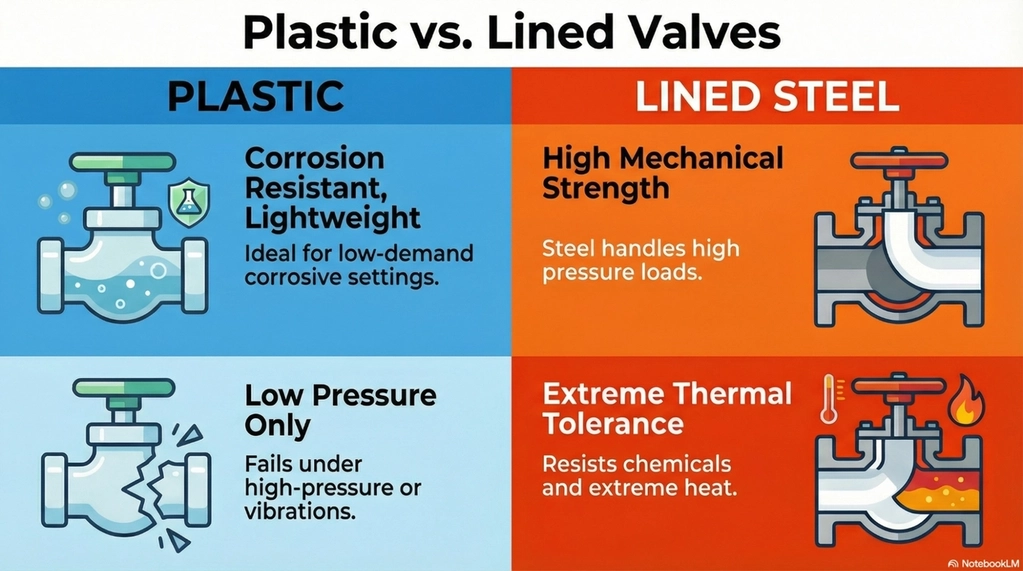
PTFE lined butterfly valve and hard seal butterfly valve differ in terms of performance characteristics in industrial flow control components. Therefore, engineers must choose an accurate design to prevent process failures and leakages. This article clarifies which valve suits particular piping requirements and operational conditions.

PTFE (Polytetrafluoroethylene) lined butterfly valve has a lining material made of fluorine plastic. It has two contact surfaces and can be made of one or more soft materials.

The following are the advantages of PTFE lined butterfly valves:
On the other hand, hard seal butterfly valves have metal or hard materials on both sides of the sealing ring. Though it has poor sealing performance compared to PTFE, it has high temperature and wear resistance and good mechanical properties.
For example: steel–steel, steel–copper, steel–graphite, and steel–alloy steel combinations. The base steel may also include cast iron, cast steel, alloy steel, or surfaces enhanced through overlaying or thermal spraying.
The following are the advantages of hard seal valves:
PTFE lined butterfly valves remain chemically ideal against almost all acids, bases, and solvents found in industrial processing. The lining fully incorporates the internal valve surfaces to prevent fluid contact with the base metal. This structure is suitable for handling aggressive chemical media that would otherwise corrode standard steel components.
Hard seal butterfly valves, meanwhile, lack the inherent chemical passivity of fluoropolymers. They commonly require expensive, high-nickel alloys to resist chemical attack. If the process fluid is corrosive, the metal seat may degrade that lead to seat leakage or component failure over time.
Choosing the right material needs an accurate analysis of the process fluid composition. For chemical processing, the PTFE provides a secure and leak-proof solution that reduces the risk of material degradation. For basic piping systems with mild fluids, hard seals may suffice.
The PTFE valve can be used at room temperature and normal pressure, while the hard sealed valves can be used at lower, room, or high temperatures and other conditions.
PTFE material has strong corrosion resistance against various media, such as strong acids and alkalis. At the same time, it also has certain heat and cold resistance properties, with an adaptable temperature between -196 and 200 °C.
The hard sealing valve adopts a precise J-shaped elastic sealing ring and a triple eccentric multi-layer metal hard sealing structure. It is widely used in electric power, metallurgy, petrochemical, municipal building, water supply and drainage, and other industrial pipelines with medium temperature below 425°C.
Process engineers must carefully assess the maximum operating temperature before finalizing valve specifications. Using a lined valve outside its thermal window ensures a short service life.
Initial procurement costs often favor the PTFE lined valve option for specific chemical applications. However, the total cost of ownership usually relies on the maintenance cycles and replacement frequency. Commonly, lined valves may need frequent inspection to ensure the fluoropolymer layer remains intact and durable.
In contrast, hard seal units involve a higher upfront capital investment because of their precise machining requirements. Though their sealing ability is weaker, their longevity in high-pressure, abrasive applications often justifies this higher initial expenditure. They also resist wear from slurries or particulate-heavy fluids better than soft-seated designs.
Lifecycle value depends on matching the valve to the specific duty cycle of the facility. A properly selected valve minimizes downtime and prevents any financial burdens of unplanned maintenance shutdowns. Regardless, budget considerations should account for long-term operational performance rather than just initial purchase price.
| Features | PTFE Lined Butterfly Valve | Hard Seal Butterfly Valve |
| Sealing Material | Soft fluoropolymer (PTFE lining) | Metal or hard-material seat |
| Chemical Resistance | Excellent for acids, bases, and solvents | Moderate, depending on alloy material |
| Temperature Range | Typically −196°C to 200°C | Up to about 425°C |
| Sealing Performance | Very high, low leakage | Lower than PTFE but stable under stress |
| Wear Resistance | Moderate | High, suitable for abrasive media |
| Mechanical Strength | Lower than metal seals | Strong mechanical durability |
| Typical Applications | Chemical processing, corrosive fluids | High-temperature, high-pressure systems |
| Cost & Maintenance | Lower initial cost, needs lining inspection | Higher upfront cost, longer service life |
Discover our strict quality control and state-of-the-art facilities ensuring the highest standard for every valve.
Explore ProcessChoosing between PTFE lined butterfly valve and a hard seal butterfly valve requires evaluating different factors, like temperature and pressure, chemical compatibility, cost, and longevity. PTFE offers superior chemical protection, while hard seals are ideal for abrasive environments. Accurate selection guarantees long-term system integrity and overall operational safety.
Lianke provides comprehensive lined valve solutions for diverse industrial valve needs. Our dedicated R&D team continuously collaborates closely with customers to make products that meet specific requirements, especially in industrial pipeline fluid filtration and anti-corrosion valve equipment.
You can explore our products’ diverse applications to find solutions that match your process needs for durability and flow control efficiency.

Valves are everywhere in industrial processes—controlling flow, isolating equipment, and protecting systems from overpressure. Yet for many engineers and technicians, the range of options can feel overwhelming. This guide covers the fundamentals of industrial valves, with a closer look at three widely used types: the lined valve, the pinch valve, and the stainless steel ball […]

Valve installation looks simple on paper—until you’re on-site, the flanges don’t line up, and the process fluid is waiting. In reality, poor installation is one of the leading causes of premature valve failure, leakage, and costly downtime. Whether you’re working with a lined valve, a strainer, or a pinch valve, the same fundamental rules apply. […]

Lianke Valve Co., Ltd. has just wrapped up a busy and rewarding season of site visits. Over the past two weeks, we have hosted several groups of clients from home and abroad. They came with different goals, yet all turned their attention to Lianke’s manufacturing strength and technical expertise. Juhua Group, Quzhou In early March, […]

Recently, the production workshop at Lianke Valve has been bustling with activity, where production, inspection, packaging and other processes operate in efficient coordination. After rigorous multi-stage quality checks, a batch of high-quality pinch valve products has been packed and shipped, setting off for Russia. Export Product Case The pinch valves in this bulk shipment are […]