
Selecting the appropriate explosion proof valve is essential for safety in industries that pose explosion risks. ATEX certified valves guarantee compliance with European standards, preventing ignition sources from heat, sparks, or static electricity.
This blog explores key factors for choosing ATEX certified explosion proof valves that ensure overall operational safety, highlighting the entailed regulations and how they influence the selection of industrial valves for hazardous conditions.

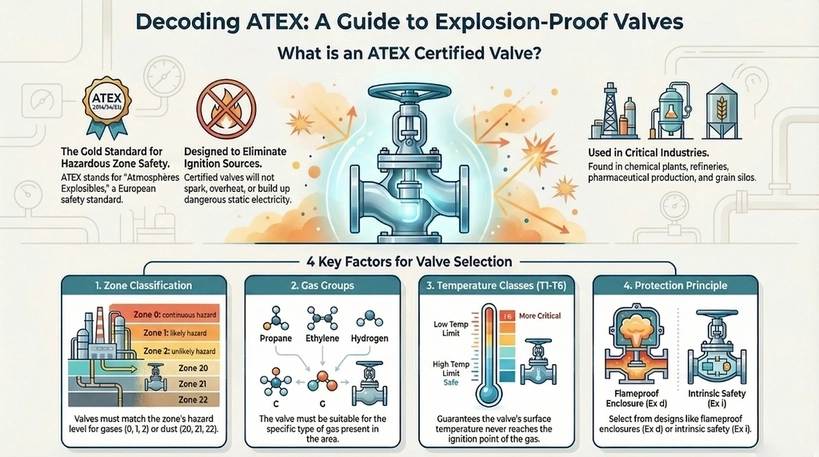
ATEX stands for “Atmosphères Explosibles,” a European safety standard (2014/34/EU) for equipment used in areas where there’s a risk of explosion, such as chemical plants, refineries, flammable gases, vapors, dust, or grain silos. An ATEX certified valve means it has been tested and approved to be safe in those hazardous environments and will not spark, overheat, or cause any static buildup that could ignite an explosion.
For instance, he صمام الضغط for pharmaceutical production uses an anti-static pinch valve with a conductive rubber sleeve to eliminate static charges and prevent the ignition of solvents or powders. These hazardous area valves offer a zero-leakage closure, making it a popular option for sensitive applications like handling sterile fluids without contamination while adhering to ATEX compliance in cleanrooms or explosive dust zones.
Hazardous zones are classified under ATEX as Zone 0, 1, or 2 for gases, fumes, or mist, and 20, 21, or 22 for combustible dust. At the highest hazard level, Zones 0 and 20 are areas where an explosive atmosphere is continuously or frequently present for extended periods.
Explosion proof valves must comply with these zones to prevent internal explosions from propagating outward. Features include flameproof enclosures (Ex d), increased safety (Ex e), or intrinsic safety (Ex i) designs that limit energy to non-ignition levels.
Gas that is present in the area is categorized according to explosion groups and temperature classes. The temperature class (T1-T6) indicates the ignition temperature of the gas or gas mixture.
ATEX certified valves commonly integrate these classes to avoid surface heating beyond ignition points, together with IP66/67 enclosures for dust and water ingress protection. Certifications like IECEx match ATEX for global use, ensuring reliability in demanding environments.
Depending on the present temperature class of the gas, an approved surface temperature of electrical equipment is given. If the maximum ambient temperature is not mentioned, a value of 40°C is assumed.
This is categorized as Ex-I input via barrier or enclosure of the electrical connections through junction box or encapsulation.
Overall, prioritizing explosion proof valves not only ensures strict adherence to international safety regulations, such as ATEX standards, but also critically enhances operational safety and reliability across a multitude of high-risk sectors.
As a specialized provider of different kinds of valves, ليانكي offers products certified to rigorous international standards, positioning them as a reliable partner for companies aiming to secure their assets, employees, and process integrity by utilizing top-tier, compliant flow control solutions.
Discover our strict quality control and state-of-the-art facilities ensuring the highest standard for every valve.
Explore Process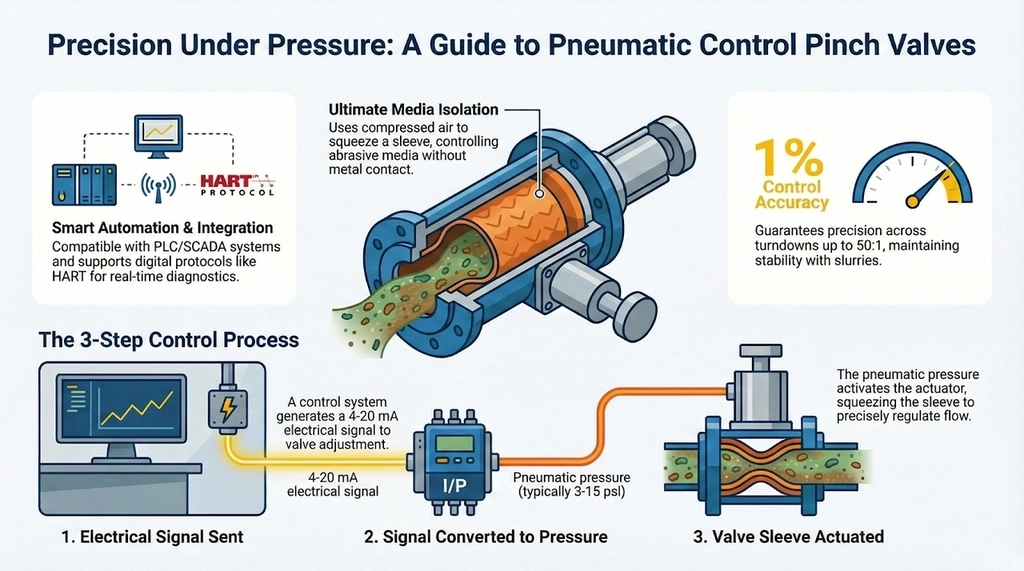
Industrial automation systems require valves that deliver precise flow control without compromising reliability in corrosive or abrasive media. A pneumatic control pinch valve excels as a modulating control valve, enabling precise flow to control pressure, temperature, or fluid levels. Using compressed air to gradually adjust the valve position allows smooth process control in mining, wastewater, […]
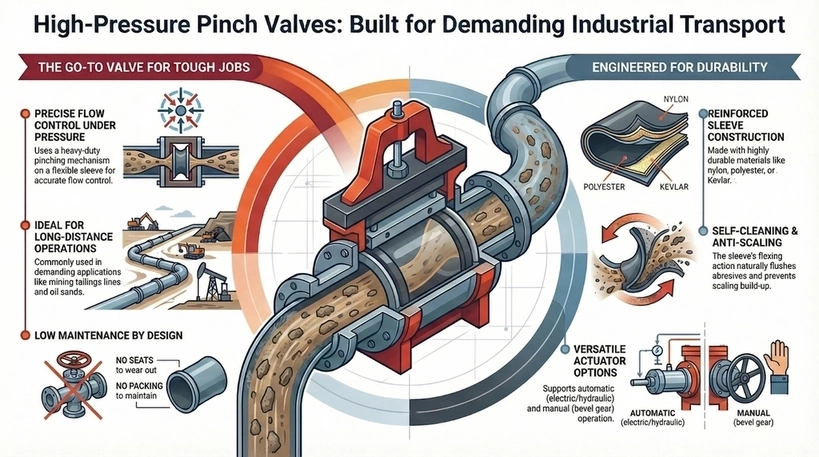
High pressure pinch valves, like PN16 pinch valve and class 150 pinch valve designs, involve a rugged and heavy-duty pinching mechanism in positioning the sleeve, resulting in an almost accurate and measurable flow of media. This kind of valve is popular and commonly used for long distance operations in mining tailings lines or oil sands, […]
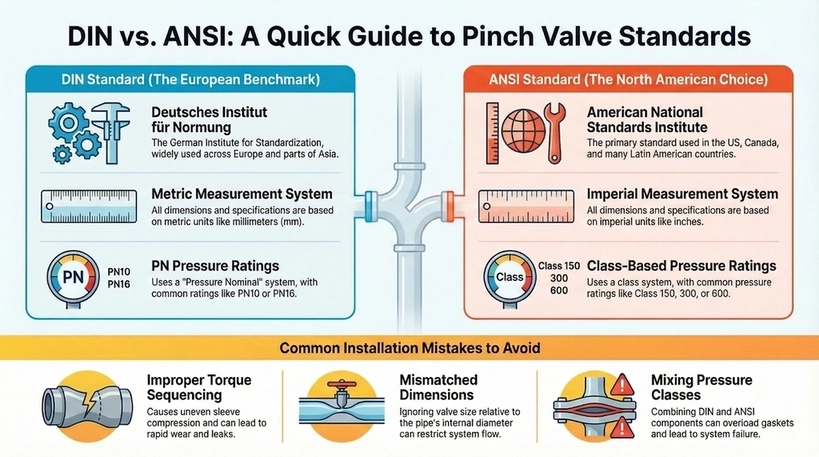
Understanding pinch valve dimensions and flanges ensures seamless integration into piping systems, particularly when choosing between DIN vs ANSI. The two are different but commonly used standards by organizations in engineering, manufacturing, and product design. DIN was developed in Germany but widely adopted across Europe and parts of Asia. Meanwhile, ANSI standards, which originate from […]
Selecting the appropriate explosion proof valve is essential for safety in industries that pose explosion risks. ATEX certified valves guarantee compliance with European standards, preventing ignition sources from heat, sparks, or static electricity. This blog explores key factors for choosing ATEX certified explosion proof valves that ensure overall operational safety, highlighting the entailed regulations and […]