
Lined valve low fugitive emission solutions help address a major challenge in modern industrial facilities. Fugitive emissions represent a major challenge for modern industrial facilities. These unintentional leaks of gases or vapors happen at process equipment connections, gaskets, and seals, negatively affecting environmental safety and operational emissions efficiency.
Regulating these leaks is a primary objective for engineers managing chemical and petrochemical plants. This is one of the main reasons why today, many different standards exist to assess the emission level, focusing primarily on valves. This guide explores strategies to minimize fugitive emissions and improve system performance.
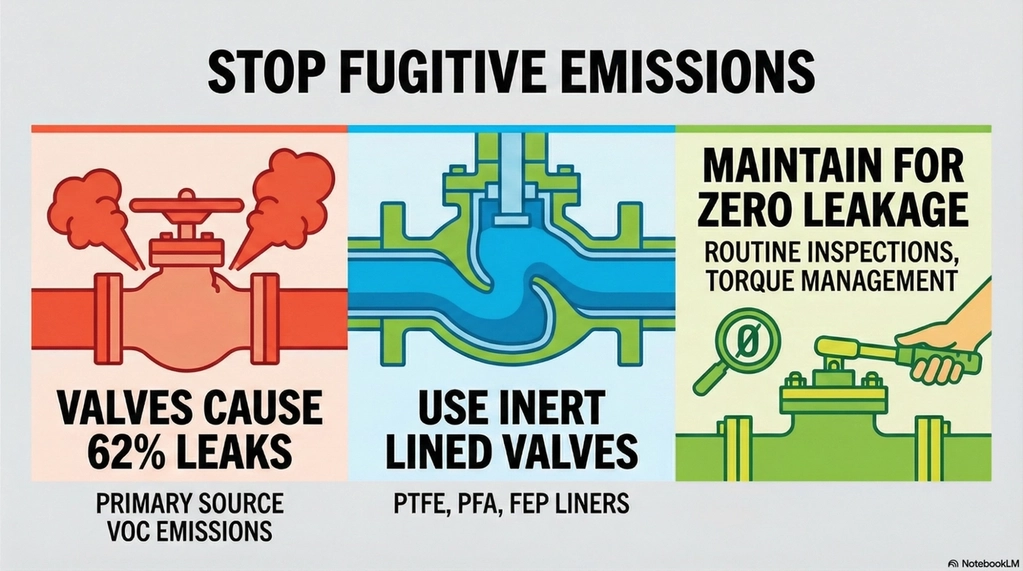
Volatile organic compounds (VOCs), such as benzene, methane, and ethanol, are the primary concerns caused by fugitive emissions. These uncontrolled gas leaks from process equipment can harm air quality and contribute to ozone formation. Hence, regulations are made to limit these emissions, and noncompliance may lead to fines.
There are numerous variables that influence how effectively a valve contains process media. For instance, high-pressure systems increase the force acting on sealing interfaces, possibly causing microscopic gaps. Meanwhile, extreme temperatures can damage seal materials over time, leading to deformation or hardening.
The nature of the fluid also dictates the choice of valve components. For instance, a valve for chlorine gas service needs robust, inert liners that are resistant to corrosion and structural breakdown to prevent leakages, as chlorine is highly reactive. Not compatible materials may lead to chemical erosion and compromise the seal integrity.
Operational cycles also contribute significantly to the overall system performance. Frequent valve actuation accelerates mechanical wear on valve stems and seating surfaces. Therefore, without precise control, the valve stem’s physical movement can dislodge packing material and may open small leak paths that release processed gases into the atmosphere.
Selecting the right design remains the most vital factor for long-term emission control. Engineers must evaluate the specific service conditions before specifying valve types. Incorrect valve sizing or poor installation alignment can cause uneven stress on the seals and can cause fugitive emissions regardless of packing quality.
The adoption of specific sealing technologies is highly vital. Dynamic and static seals on valves are primary sources of fugitive emissions, with valves contributing about 62% of uncontrolled VOC emissions at a typical facility. Using low-emission (low-E) valves, which testing shows significantly reduces fugitive emissions, is a widely adopted industry solution.
A lined valve with low fugitive emission design offers a barrier between the corrosive media and the valve body. By using chemically inert liners, like FEP, PFA, and PTFE, manufacturers create a continuous, leak-proof interior. This helps prevent chemical attack on the metal housing and maintains structural integrity in the long run.
Lined valves provide distinct benefits in harsh environments. Below are its various sealing methods and advantages. Choosing the right valve and sealing technology prevents product loss, emissions, and regulatory issues. :
A zero-leakage goal needs a disciplined maintenance program. Here is what you can do to achieve it:
Discover our strict quality control and state-of-the-art facilities ensuring the highest standard for every valve.
Explore ProcessFugitive emissions management is essential for the safety and efficiency of industrial processes. By addressing the root causes of leaks, operators can maintain containment. Furthermore, implementing robust sealing technologies and proper maintenance schedules allows facilities to minimize gas release and improve overall sustainability.
Lianke specializes in offering durable valve solutions for demanding chemical applications. With over 20 years of manufacturing experience, we produce in-house PTFE/PFA/FEP lined valves that are built for corrosive media and handle aggressive environments with consistent performance.
For plants needing specific solutions, the factory supports custom OEM production to meet unique flange and pressure standards.

Valves are everywhere in industrial processes—controlling flow, isolating equipment, and protecting systems from overpressure. Yet for many engineers and technicians, the range of options can feel overwhelming. This guide covers the fundamentals of industrial valves, with a closer look at three widely used types: the lined valve, the pinch valve, and the stainless steel ball […]

Valve installation looks simple on paper—until you’re on-site, the flanges don’t line up, and the process fluid is waiting. In reality, poor installation is one of the leading causes of premature valve failure, leakage, and costly downtime. Whether you’re working with a lined valve, a strainer, or a pinch valve, the same fundamental rules apply. […]

Lianke Valve Co., Ltd. has just wrapped up a busy and rewarding season of site visits. Over the past two weeks, we have hosted several groups of clients from home and abroad. They came with different goals, yet all turned their attention to Lianke’s manufacturing strength and technical expertise. Juhua Group, Quzhou In early March, […]

Recently, the production workshop at Lianke Valve has been bustling with activity, where production, inspection, packaging and other processes operate in efficient coordination. After rigorous multi-stage quality checks, a batch of high-quality pinch valve products has been packed and shipped, setting off for Russia. Export Product Case The pinch valves in this bulk shipment are […]

