Question 3:Performance Confirmation:Your documentation mentions “zero leakage” and “clog resistance.” We would like to confirm:
After long-term operation, will repeated compression cycles cause sleeve fatigue leading to sealing failure? Is the full-bore design truly effective for slurries with larger particles (e.g., 3-5mm)?
Answer 3:Confirmation of “Zero Leakage” and “Clog Resistance” Performance
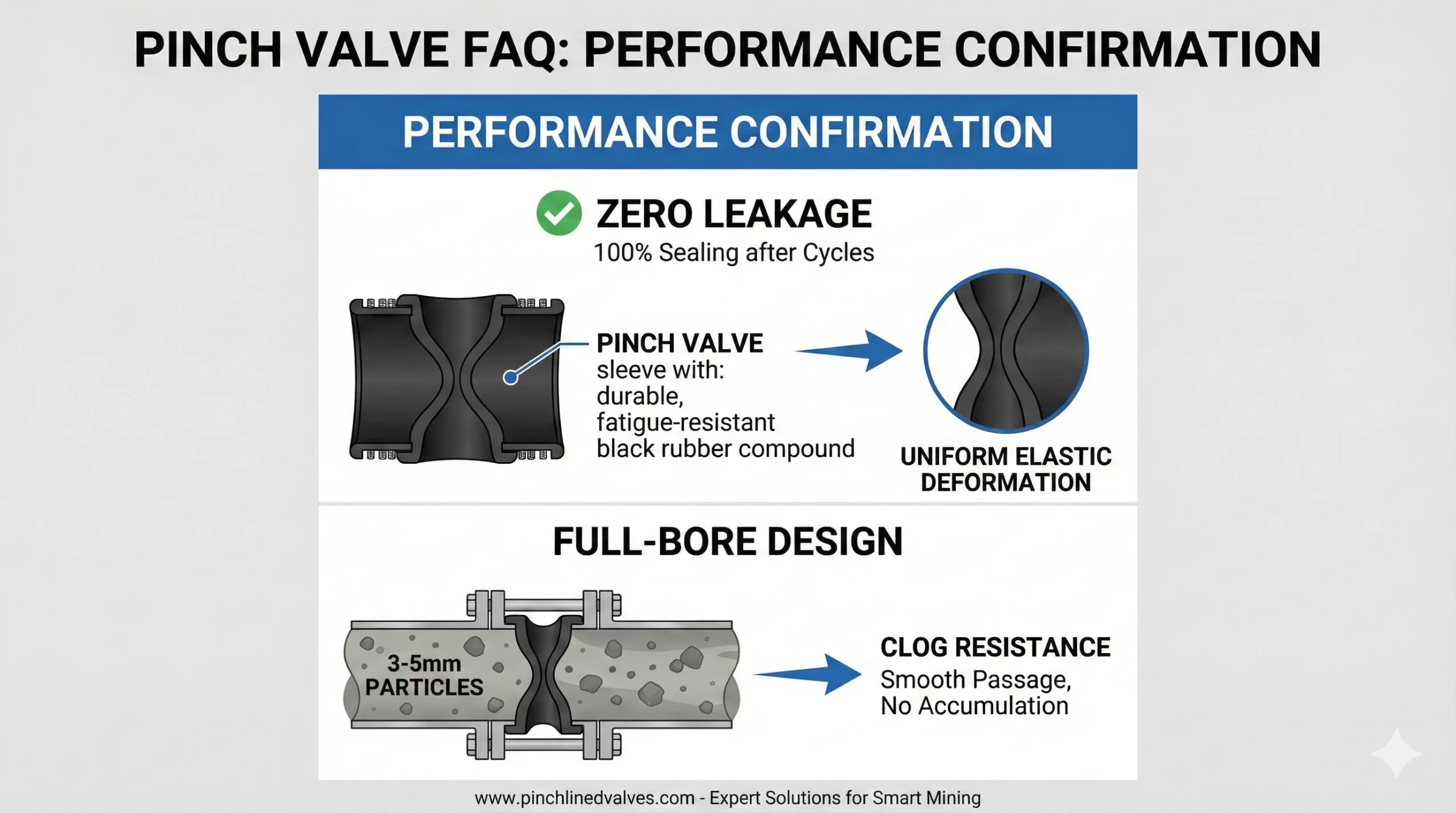
(1)Zero Leakage Reliability: Our pinch valves use specialized rubber compounds formulated for high strength and fatigue resistance. The sleeve compression during closing involves uniform elastic deformation. Their fatigue life has been rigorously tested to ensure 100% zero leakage sealing during each closing cycle throughout the rated service life. Replacement of the sleeve component is only required at the end of the service interval, and the operation is straightforward.
(2) Clog Resistance Capability: The full-bore, cavity-free design is key to clog resistance. For particles of 3-5mm, the valve provides a flow path consistent with the pipeline inner diameter when open, allowing straight-through media passage without obstruction, completely avoiding the possibility of accumulation within a valve cavity. This reliability is far superior to traditional gate valves or ball valves.
4. Question: Automation Integration: Do the electric actuators support standard 4-20mA or Modbus communication protocols for seamless integration with our existing DCS system to achieve precise flow and pressure interlock control?
Answer 4:Regarding Automation Integration Yes, our electric actuators are standard configured to fully support 4-20mA analog signal input/outputfor receiving control signals and providing valve position feedback. Additionally, mainstream fieldbus communication protocols such as Modbus RTU or Profibus-DPare available as options. They can be easily integrated with your DCS system to achieve precise remote control, status monitoring, and intelligent interlocking, fully meeting the automation control requirements of smart mining.
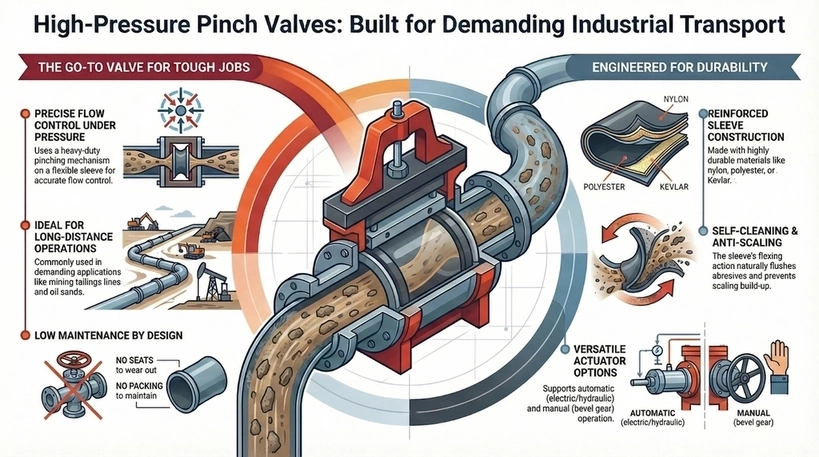
High pressure pinch valves, like PN16 pinch valve and class 150 pinch valve designs, involve a rugged and heavy-duty pinching mechanism in positioning the sleeve, resulting in an almost accurate and measurable flow of media. This kind of valve is popular and commonly used for long distance operations in mining tailings lines or oil sands, […]
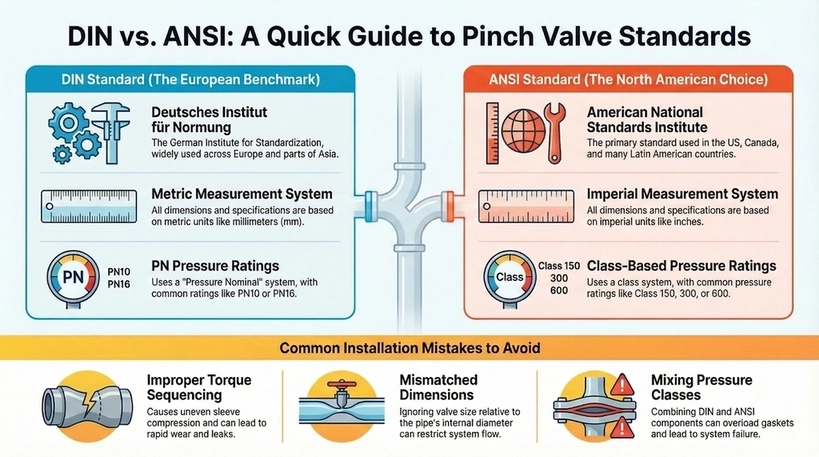
Understanding pinch valve dimensions and flanges ensures seamless integration into piping systems, particularly when choosing between DIN vs ANSI. The two are different but commonly used standards by organizations in engineering, manufacturing, and product design. DIN was developed in Germany but widely adopted across Europe and parts of Asia. Meanwhile, ANSI standards, which originate from […]
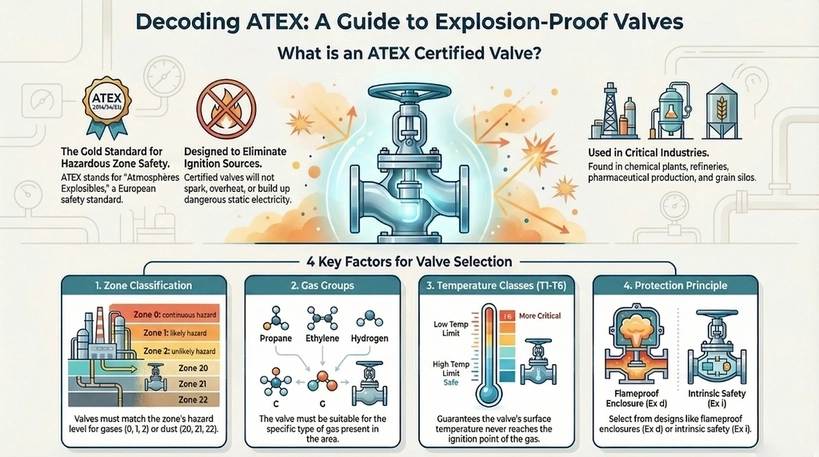
Selecting the appropriate explosion proof valve is essential for safety in industries that pose explosion risks. ATEX certified valves guarantee compliance with European standards, preventing ignition sources from heat, sparks, or static electricity. This blog explores key factors for choosing ATEX certified explosion proof valves that ensure overall operational safety, highlighting the entailed regulations and […]
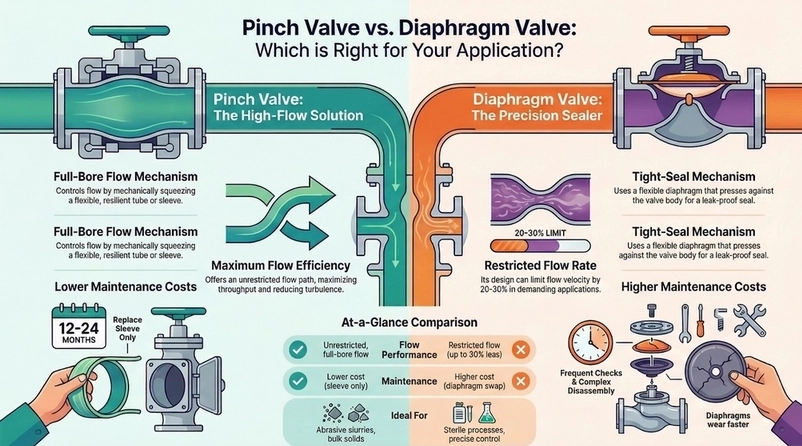
When handling abrasive or viscous media in industrial processes, the type of valve used can heavily affect the performance, efficiency, and overall user experience. In relation to this, two of the most common valve options are pinch and diaphragm valves. In this blog, we delve into the pinch valve vs diaphragm valve discussion, analyzing flow […]